On the Online Front: ‘Jerusalem behind the headlines’

Featured

It looks like my next piece just got published. I think this Jerusalem Post Metro piece, titled “On the Online Front,” will be interesting for those interested in learning about Israel’s PR behind the scenes, both the good, bad, and complicated aspects of it. What is also unique about this piece is that the group, called Ambassadors Online, consists of a number of Arab students, which are usually underrepresented in such public diplomacy activities. Without further ado, here is the article (beyond the paywall). As always, let me know what you think.

_ _ _ _ _

On the online front

A diverse group of University of Haifa students gains skills in new media and learns about ‘Jerusalem behind the headlines’ to represent Israel in the Internet age.
By LAURA ROSBROW
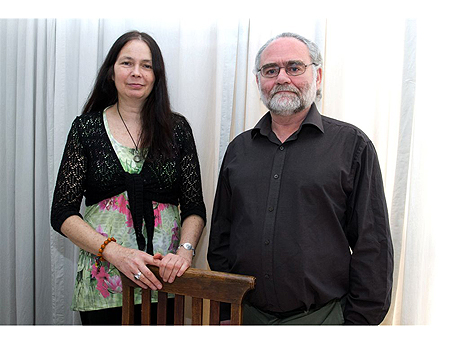
Haifa University students
Photo by: Ifat Segal

‘I’m an Israeli citizen, and many things are said about Israel that are not true. I want to show a true picture of Israel. It’s not all protests.”

Ayat Rahal does not fit the typical profile of a pro- Israeli hasbara, or public diplomacy, activist. She is a Muslim Beduin student at the University of Haifa from Rumat al-Heib in the Galilee. For her, participating in Ambassadors Online (Shagririm Bareshet), which trains students to represent Israel as unofficial ambassadors in the international arena, is crucial for promoting coexistence. “As a Muslim, I think [doing hasbara] is important for coexistence. People don’t understand that we live together, we study together, and do everything together. I want to show what life is really like here.”

Rahal, several Druse participants, a Polish exchange student, a Jewish new immigrant from Venezuela and 25 Jewish Israelis make up Ambassadors Online’s second cohort. The students were chosen from over 60 applicants, with more applicants in this round than the first group last year.

Ambassadors Online’s goal is to train students in new media skills, such as social media, blogging and filmmaking, so they can defend and represent Israel online. David Gurevich, a PhD candidate in the Department of Archeology at the University of Haifa and the program’s director, founded the program last year with Prof. Eli Avraham, a senior faculty member in the Department of Communications. The project is co-sponsored by the university, its student union and the ISEF Foundation. Although the cohort was supposed to begin in the fall semester, it was delayed to the spring semester because of a lack of funds.

Gurevich says the group’s diversity reflects the range of students that are passionate about representing Israel: “You can see that we have totally various populations here. What unites everyone is they feel connected to this country and want to stand for it.”

He also says that Ambassadors Online does not have a political orientation. “We’re saying, ‘Guys, you can be Left, you can be Right.’ The idea is we have a lot more in common here as Israelis, and that we can represent that common ground for the world.”

Several Jewish students wanted to participate because they feel Israel is misunderstood abroad. Maya Zaliuk- Sharabany says, “I wanted to be in this project because whenever I go abroad, it is hard for me to talk about Israel, to answer people’s questions. I’m glad to take a course that prepares me to do that.”

For Maya Beinin, the rationale behind Israel’s actions is obvious. But she does not think this understanding translates to foreign audiences. “Israel’s hasbara is really bad. The world doesn’t understand us.”

Perhaps Adam Asad, a master’s student in international relations who wants to become a diplomat, will improve Israeli hasbara in the future. Like Rahal, he also does hasbara in part to promote coexistence. “I really want to represent Israel from my point of view as Arab, as Druse, from Israel. I want to show the Israeli side. It’s not understood in the world that there are Arabs in Israel and they can represent Israel… I believe in coexistence.

I believe in interfaith dialogue inside and outside of Israel. That’s why I attended this program.”

To familiarize participants with the central issues that make up headlines about Israel, Gurevich leads a tour called “Jerusalem behind the headlines.” In the tour, the group visits controversial places in the Jerusalem area – such as the Temple Mount and Ma’aleh Adumim – as well as the Foreign Affairs Ministry. Gurevich hopes the tour shows “how complicated the situation is, and some information about the solutions so each one can go home and decide for himself.” This reporter had the privilege to join the tour.

On the two-and-a-half-hour bus ride from Haifa to Jerusalem, Gurevich lectures almost the entire time.

He covers many of the main aspects of a peace agreement between Israel and the Palestinians, providing facts that defend Israel or complicate one’s views towards solutions to the Israeli-Palestinian conflict.

For most of the participants on the tour, it is their first time visiting the Temple Mount. Many smile, rush to take pictures of the golden dome and pose with friends as Gurevich guides.

Later in the tour, the group visits the intersection where Ma’aleh Adumim borders E1, a hotly contested territory adjacent to east Jerusalem. Although Gurevich says that E1 “does create a territorial sequence for Israel,” which some claim threatens the feasibility of a contiguous future Palestinian state, “that it prevents territorial continuity in the Palestinian state, that is just not true factually… What it does is prevent connecting east Jerusalem to that future Palestinian state… Right, not right, smart, not smart, that’s the situation. But it’s important to know the facts. The fact is that building in E1 does not prevent a two-state solution.”

Gurevich first statement that it is important to know “the facts,” and his further statement that building in E1 does not prevent a two-state solution illustrates part of the tour’s perspective.

The next stop is the Foreign Ministry, where officials present Israel’s hasbara strategy to Ambassadors Online. Ilana Stein, ministry vice spokeswoman, discusses hasbara’s “creative energy” strategy, which focuses on topics such as start-ups, the arts, and “cool” events taking place in Israel. The goal is for more people to engage with Israel through positive, non-political channels. She also encourages Ambassadors Online participants to write about fun experiences on social media sites so that peers can relate to Israel. Her motto for participants is, “Be truthful, authentic, say things that are fun.”

Although Stein’s advice is helpful, this reporter wanted to hear from the ministry about how it deals with the most difficult arguments against Israel.

When Eliya Rubinstein Benditovich, the ministry’s head of new media, is asked what the hardest question she ever found on the Internet was, she says, “The hardest questions are about delegitimization.

‘Why are you doing this?’ And it’s hard to answer because sometimes, yes, we’re doing this.” She then talks about what the office does during times of conflict.

This makes her reflect on Israel’s most recent operation, Pillar of Defense, which ended after a week of strikes between Gaza and Israel in November. “If the state had decided to continue with [the operation], our duty is to go along with it, to represent it.”

Therein lies hasbara’s greatest challenge: to make the case for all of Israel’s actions to audiences abroad.

Already, Ambassadors Online participants have organized a hasbara conference and created videos, blogs and pro-Israeli Facebook groups. Only time will tell if these students are up to the tough task of representing Israel. •
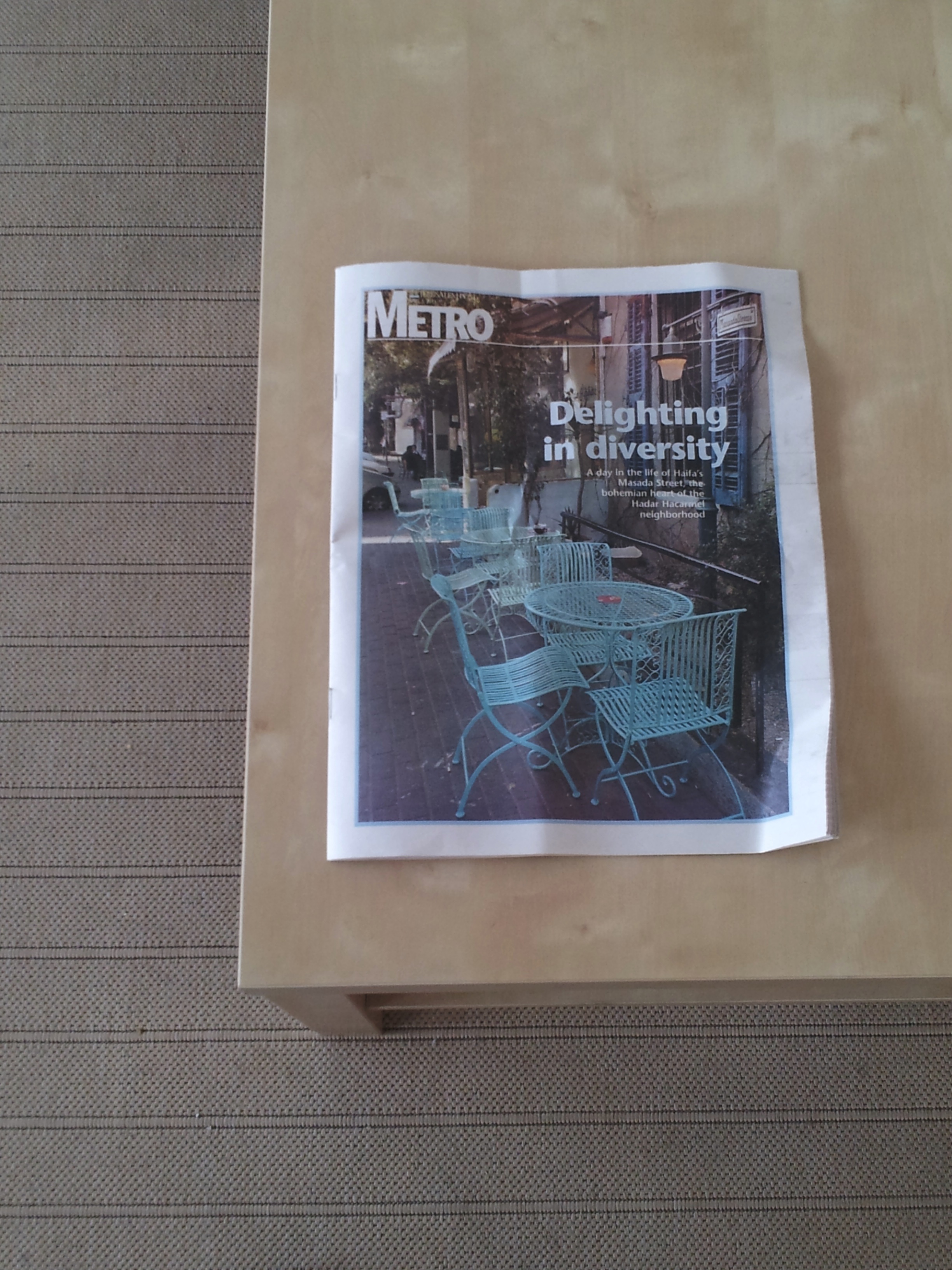
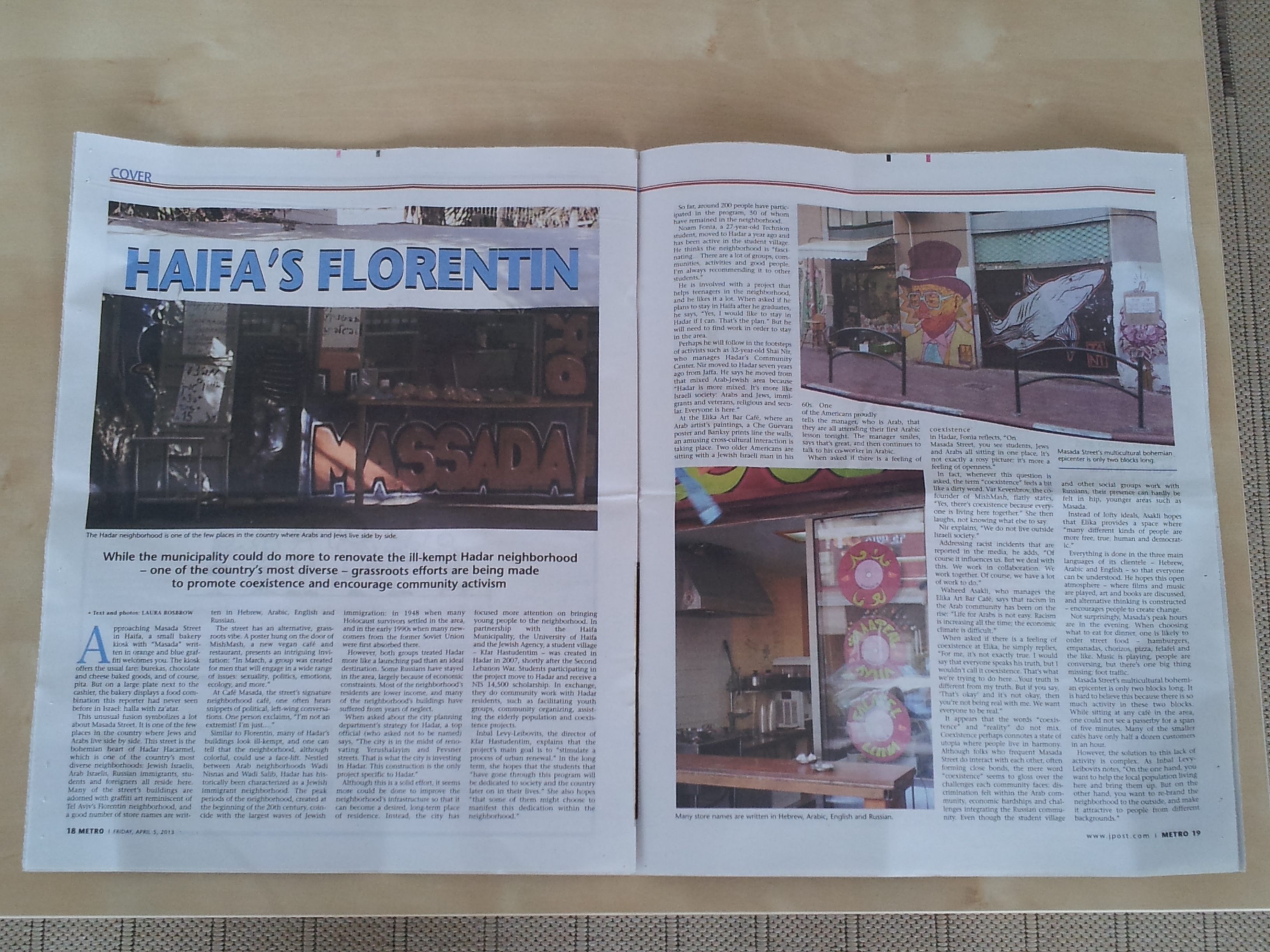
Cover of the Jerusalem Post Metro!

Featured

The article I recently published about the mixed Jewish-Arab neighborhood in Haifa made it to the cover of the Jerusalem Post Metro!

Metro Cover- Haifa's Florentin

In addition to the whole cover story thing, I took the photo on the cover, as well as the photos in the article itself. This is the first time in my professional life that I’ve gotten paid for photos, so that was a nice experience.

Haifa's Florentin Article

Thanks everyone for your interest in my work and your support. It means a lot.

Next week I have at least one, if not a few stories coming out. Stay tuned.

Help me redesign my website!

Featured

Hi readers,

I decided to pay a little extra at WordPress to upgrade the blog. First, the domain now is laurarosbrow.com instead of laurarosbrow.wordpress.com. So that’ll be easier to remember.

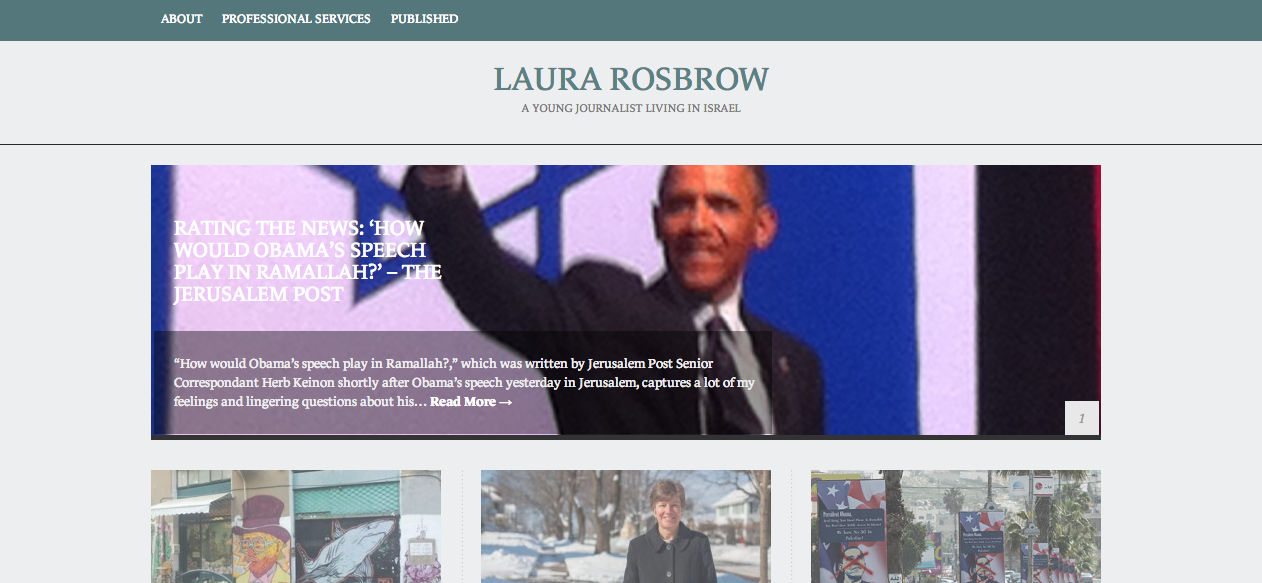
The other big thing is that I can customize the appearance. I have been thinking for a while about creating a static front page instead of a “bloggy” front page with all my recent posts.

So, I’ll give two options. One is how the website looks currently:

Option 1: Bloggy front page

Laura Rosbrow's front page

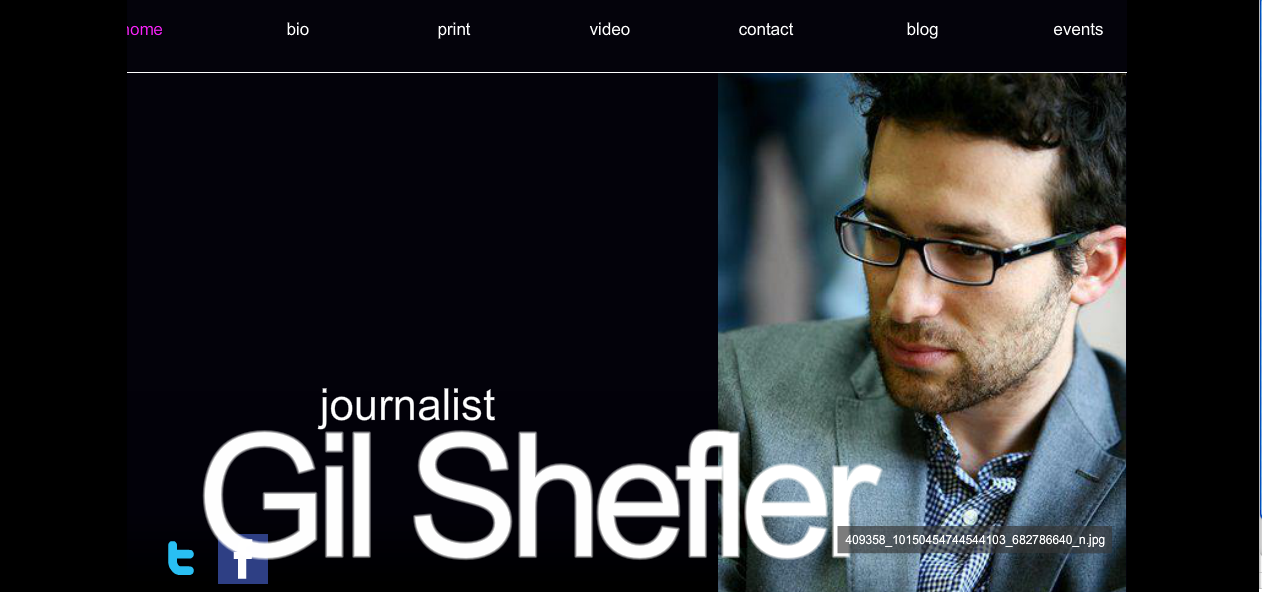
Or a more static front page. Say, like my friend Gil Shefler‘s website:

Option 2: Static front page

Gil Shefler's home page

Which option do you prefer? I’d really appreciate your input!!

Profile of a mixed Jewish-Arab neighborhood in Haifa

Featured

I published a piece in The Jerusalem Post‘s Metro section about Masada street, the vibrant, bohemian center of Haifa’s Hadar neighborhood. The piece, titled “Haifa’s Florentin,” (which references a hip neighborhood called Florentin in Tel Aviv), profiles the neighborhood and describes some grassroots efforts being made here. It also examines what coexistence means for people living in this mixed Jewish-Arab neighborhood.

Since the article is pay-walled, I have copied the article below. As always, let me know what you think.

_ _ _ _ _ _ _

Haifa’s Florentin

While the municipality could do more to renovate the ill-kempt Hadar neighborhood – one of the country’s most diverse – grassroots efforts are being made to promote coexistence and encourage community activism.

By LAURA ROSBROW

Masada Street

Photos by Laura Rosbrow


Approaching Masada Street in Haifa, a small bakery kiosk with “Masada” written in orange and blue graffiti welcomes you. The kiosk offers the usual fare: burekas, chocolate and cheese baked goods, and of course, pita. But on a large plate next to the cashier, the bakery displays a food combination this reporter had never seen before in Israel: halla with za’atar.

This unusual fusion symbolizes a lot about Masada Street. It is one of the few places in the country where Jews and Arabs live side by side. This street is the bohemian heart of Hadar Hacarmel, which is one of the country’s most diverse neighborhoods: Jewish Israelis, Arab Israelis, Russian immigrants, students and foreigners all reside here.

Graffiti


Many of the street’s buildings are adorned with graffiti art reminiscent of Tel Aviv’s Florentin neighborhood, and a good number of store names are written in Hebrew, Arabic, English and Russian.

The street has an alternative, grassroots vibe. A poster hung on the door of MishMash, a new vegan café and restaurant, presents an intriguing invitation: “In March, a group was created for men that will engage in a wide range of issues: sexuality, politics, emotions, ecology, and more.”

At Café Masada, the street’s signature neighborhood café, one often hears snippets of political, left-wing conversations.

One person exclaims, “I’m not an extremist! I’m just.…”

Falafel

Similar to Florentin, many of Hadar’s buildings look ill-kempt, and one can tell that the neighborhood, although colorful, could use a face-lift. Nestled between Arab neighborhoods Wadi Nisnas and Wadi Salib, Hadar has historically been characterized as a Jewish immigrant neighborhood. The peak periods of the neighborhood, created at the beginning of the 20th century, coincide with the largest waves of Jewish immigration: in 1948 when many Holocaust survivors settled in the area, and in the early 1990s when many newcomers from the former Soviet Union were first absorbed there.

However, both groups treated Hadar more like a launching pad than an ideal destination. Some Russians have stayed in the area, largely because of economic constraints. Most of the neighborhood’s residents are lower income, and many of the neighborhood’s buildings have suffered from years of neglect.

When asked about the city planning department’s strategy for Hadar, a top official (who asked not to be named) says, “The city is in the midst of renovating Yerushalayim and Pevsner streets. That is what the city is investing in Hadar. This construction is the only project specific to Hadar.”

Although this is a solid effort, it seems more could be done to improve the neighborhood’s infrastructure so that it can become a desired, long-term place of residence. Instead, the city has focused more attention on bringing young people to the neighborhood. In partnership with the Haifa Municipality, the University of Haifa and the Jewish Agency, a student village – Kfar Hastudentim – was created in Hadar in 2007, shortly after the Second Lebanon War. Students participating in the project move to Hadar and receive a NIS 14,500 scholarship. In exchange, they do community work with Hadar residents, such as facilitating youth groups, community organizing, assisting the elderly population and coexistence projects.

Inbal Levy-Leibovits, the director of Kfar Hastudentim, explains that the project’s main goal is to “stimulate a process of urban renewal.” In the long term, she hopes that the students that “have gone through this program will be dedicated to society and the country later on in their lives.” She also hopes “that some of them might choose to manifest this dedication within the neighborhood.”

So far, around 200 people have participated in the program, 50 of whom have remained in the neighborhood.

Noam Fonia, a 27-year-old Technion student, moved to Hadar a year ago and has been active in the student village.

He thinks the neighborhood is “fascinating… There are a lot of groups, communities, activities and good people.

I’m always recommending it to other students.”

He is involved with a project that helps teenagers in the neighborhood, and he likes it a lot. When asked if he plans to stay in Haifa after he graduates, he says, “Yes, I would like to stay in Hadar if I can. That’s the plan.” But he will need to find work in order to stay in the area.

Perhaps he will follow in the footsteps of activists such as 32-year-old Shai Nir, who manages Hadar’s Community Center. Nir moved to Hadar seven years ago from Jaffa. He says he moved from that mixed Arab-Jewish area because “Hadar is more mixed. It’s more like Israeli society: Arabs and Jews, immigrants and veterans, religious and secular.

Everyone is here.”

At the Elika Art Bar Café, where an Arab artist’s paintings, a Che Guevara poster and Banksy prints line the walls, an amusing cross-cultural interaction is taking place. Two older Americans are sitting with a Jewish Israeli man in his 60s. One of the Americans proudly tells the manager, who is Arab, that they are all attending their first Arabic lesson tonight. The manager smiles, says that’s great, and then continues to talk to his co-worker in Arabic.

When asked if there is a feeling of coexistence in Hadar, Fonia reflects, “On Masada Street, you see students, Jews and Arabs all sitting in one place. It’s not exactly a rosy picture; it’s more a feeling of openness.”

In fact, whenever this question is asked, the term “coexistence” feels a bit like a dirty word. Var Kevenbrov, the cofounder of MishMash, flatly states, “Yes, there’s coexistence because everyone is living here together.” She then laughs, not knowing what else to say.

Nir explains, “We do not live outside Israeli society.”

Addressing racist incidents that are reported in the media, he adds, “Of course it influences us. But we deal with this. We work in collaboration. We work together. Of course, we have a lot of work to do.”

Waheed Asakli, who manages the Elika Art Bar Café, says that racism in the Arab community has been on the rise: “Life for Arabs is not easy. Racism is increasing all the time; the economic climate is difficult.”

When asked if there is a feeling of coexistence at Elika, he simply replies, “For me, it’s not exactly true. I would say that everyone speaks his truth, but I wouldn’t call it coexistence. That’s what we’re trying to do here…Your truth is different from my truth. But if you say, ‘That’s okay’ and it’s not okay, then you’re not being real with me. We want everyone to be real.”

It appears that the words “coexistence” and “reality” do not mix.

Coexistence perhaps connotes a state of utopia where people live in harmony.

Although folks who frequent Masada Street do interact with each other, often forming close bonds, the mere word “coexistence” seems to gloss over the challenges each community faces: discrimination felt within the Arab community, economic hardships and challenges integrating the Russian community.

Even though the student village and other social groups work with Russians, their presence can hardly be felt in hip, younger areas such as Masada.

Instead of lofty ideals, Asakli hopes that Elika provides a space where “many different kinds of people are more free, true, human and democratic.”

Everything is done in the three main languages of its clientele – Hebrew, Arabic and English – so that everyone can be understood. He hopes this open atmosphere – where films and music are played, art and books are discussed, and alternative thinking is constructed – encourages people to create change.

Not surprisingly, Masada’s peak hours are in the evening. When choosing what to eat for dinner, one is likely to order street food – hamburgers, empanadas, chorizos, pizza, felafel and the like. Music is playing, people are conversing, but there’s one big thing missing: foot traffic.

Masada Street’s multicultural bohemian epicenter is only two blocks long. It is hard to believe this because there is so much activity in these two blocks.

While sitting at any café in the area, one could not see a passerby for a span of five minutes. Many of the smaller cafés have only half a dozen customers in an hour.

However, the solution to this lack of activity is complex. As Inbal Levy- Leibovits notes, “On the one hand, you want to help the local population living here and bring them up. But on the other hand, you want to re-brand the neighborhood to the outside, and make it attractive to people from different backgrounds.”

Rating the news: “In Fight for Marriage Rights, ‘She’s Our Thurgood Marshall’” – The New York Times

Featured

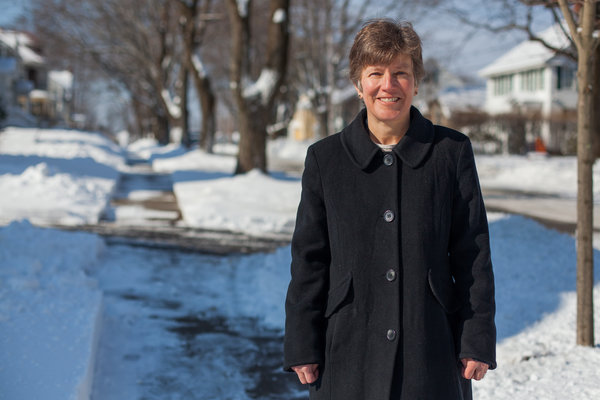
This story profiles lawyer Mary Bonauto, who “some say is almost single-handedly responsible for the same-sex marriage cases now pending before the Supreme Court.” I like these kinds of stories because it reminds us that social change happens because of individuals who put in a lot of work over a long period of time. This article from the New York Times is a nice, positive, instructive read.

Rating: Stuff that makes me happy.

Craig Dilger for The New York Times

Craig Dilger for The New York Times


Rating the News: ‘How would Obama’s speech play in Ramallah?’ – The Jerusalem Post

Featured

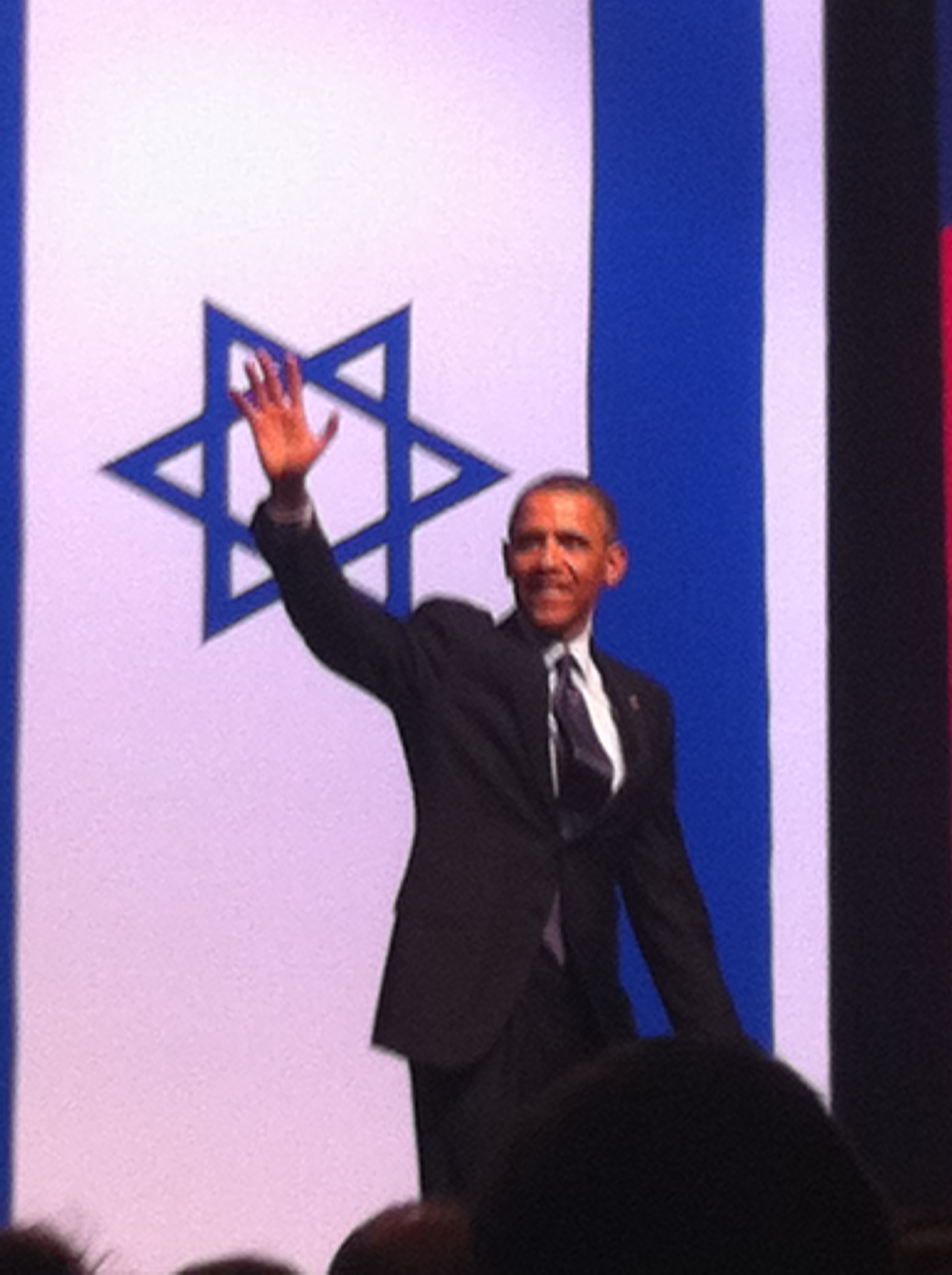
How would Obama’s speech play in Ramallah?,” which was written by Jerusalem Post Senior Correspondant Herb Keinon shortly after Obama’s speech yesterday in Jerusalem, captures a lot of my feelings and lingering questions about his visit. So, I’m just going to repost it here

Rating: Sh*t is complicated.

I’d love your thoughts on this piece and Obama’s visit in general.

Photo by Ariel Shasha, a student at Bar Ilan University.

Photo by Ariel Shasha, a student at Bar Ilan University that attended Obama’s speech.

Obama’s visit to Israel and the West Bank in Pictures

Featured

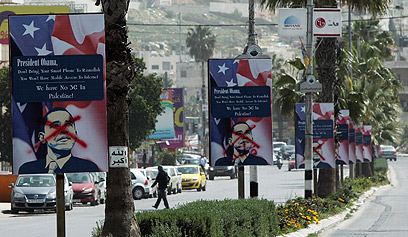
As I’ve been scouring the news the last few days, eagerly anticipating Obama’s visit, I’ve been affected by the photos. They show how differently Obama is perceived in Israel in comparison to the West Bank.

Here are photos of Obama flags in Israel before the visit:

Photo from Your Jewish News

In Jerusalem: “Unbreakable Alliance, President Obama in Israel, 2013.” Photo from Your Jewish News

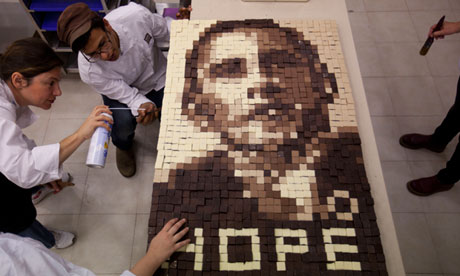
Students in Israel make an image of President Obama from chocolate. Photo from Ariel Schalit/AP

Students in Israel make an image of President Obama from chocolate. Photo from Ariel Schalit/AP

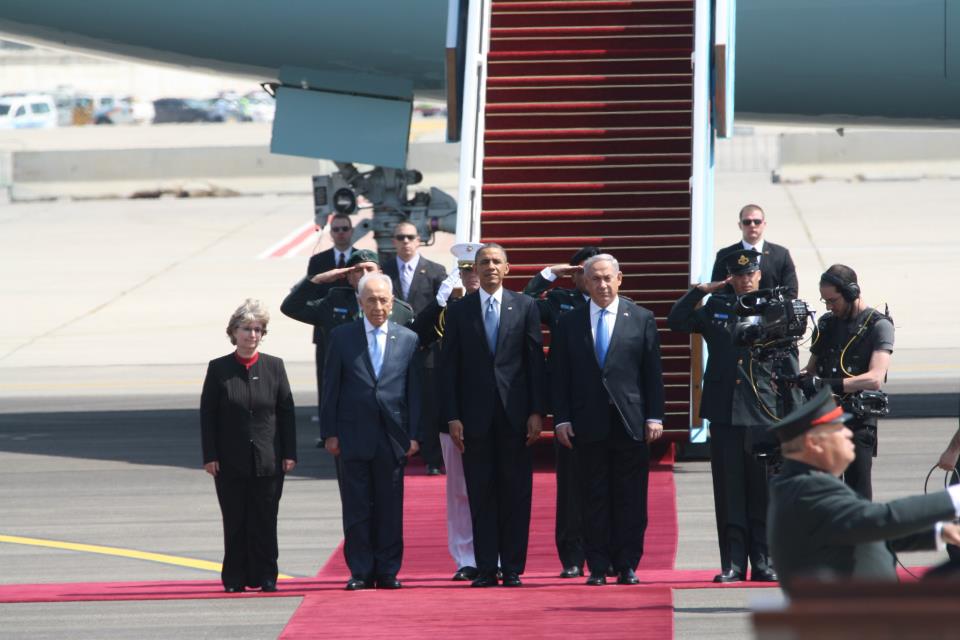
And here are the first photos of Obama in Israel. Around 1,000 people came to greet him at the airport, including a military band, politicians, and a whole lot of journalists:

The whole scene at the airport as Obama arrives. Photo from Camilla Schick, Jerusalem Post

The whole scene at the airport as Obama arrives. Photo from Camilla Schick, Jerusalem Post

President Shimon Peres, President Barack Obama, and Prime Minister Netanyahu. They all wore blue! Photo from Ben Hartman, Jerusalem Post

President Shimon Peres, President Barack Obama, and Prime Minister Netanyahu. They all wore blue ties! Photo from Ben Hartman, Jerusalem Post

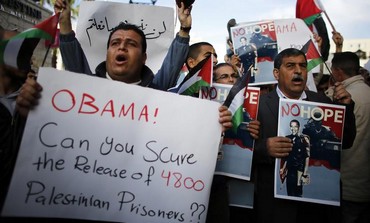
Meanwhile, this is what has been going on in the West Bank.

Palestinian protestors against Obama. Photo from REUTERS/Ammar Awad

Palestinian protestors against Obama. Photo from REUTERS/Ammar Awad

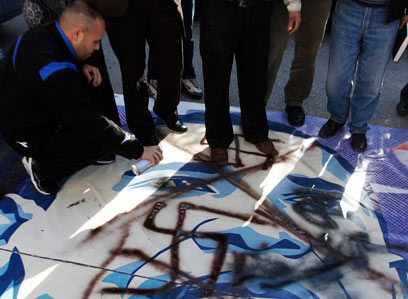
Photo from AP

Photo from AP

Photo from EPA

Photo from EPA

Obviously, many Palestinians are not pleased with Obama coming.

Obama’s already done quite a charm offensive to Israel, saying some words in Hebrew and describing the Jewish people’s 3,000-year-old connection to the land.

What will Obama do when he meets with Palestinian Authority President Mahmoud Abbas? It’s hard to imagine Obama being able to sweet talk his way out of these hostilities. Honestly, I have no idea what that kind of charm offensive could look like.

Rating the news: ‘Drinking tea with the man who killed my father’ – Ynet Magazine

Featured

This a moving story about Jo Berrya woman whose British MP father was killed by Pat Magee, a bomber from the IRA. When he was released from jail as part of final peace negotiations with Ireland, she sought to develop a dialogue with the man who killed her father. They have been in a dialogue ever since.

They both visited Israel and told Ynet their story. The piece is moving and thought provoking, and I personally doubt that I would have the fortitude to do something like Ms. Berry did. I wonder how many stories there would be like this if  peace were negotiated in Israel/Palestine?

Rating: Stuff that makes me happy/ Sh*t is complicated

Jo Berry and Pat Magee Photo: Ofer Amram

Jo Berry and Pat Magee. Photo: Ofer Amram, Ynet 

Rating the news: ‘Liberman: IDF should open fire at stone-throwers’ – The Jerusalem Post

Featured

Avigdor Liberman, Prime Minister Binyamin Netanyahu’s second hand man and Yisrael Beytenu chairman (who is also on trial for corruption), wants to change IDF rules of engagement so that soldiers should open fire at stone throwers rather than use dispersal methods, such as tear gas. My first gut reaction to this article from The Jerusalem Postwas man, this is definitely stuff that makes me mad. It’s totally messed up to shoot Palestinians that are throwing stones. A gun seems like excessive force.

Rating: Stuff that makes me mad/ Sh*t is complicated

Sh*t is also complicated because of the context behind the comment. On Thursday, The Times of Israel reported that, “Six people were injured, one critically, after stones thrown by Palestinians caused a car to collide with a truck near the West Bank settlement of Ariel.” That one critically injured was a 3-year-old. She’s currently in a hospital, fighting for her life.

Additionally, violence in the West Bank has been on the rise. Here’s a good tally of attacks from The Jerusalem Post:

“A total of 139 attacks, including firebombings and the use of improvised explosives, took place in February, compared to 83 in January.
One hundred of February’s attacks took place in the West Bank – 84 of them firebombings – compared to 56 in the previous month.
In the capital, 38 attacks – 35 of them firebombings – were registered by the Shin Bet in February, compared to 27 in January.”

In general, I support a 2-state solution and hope for as little violence as possible. I don’t want soldiers to shoot at Palestinians throwing stones, but I also want stone throwing to recede.

Maybe President Obama can give his thoughts on the subject when he visits Israel this week. Although I doubt he will, considering he’s coming here on a “listening tour.”

What do you suggest?

ShowImage

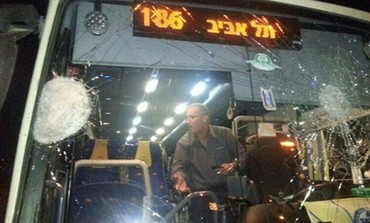
Bus damaged by stones on Route 5 near Ariel, March 14 

Photo: Channel 10

Rating the news

Featured

A lot of friends and readers have wanted to hear more of my opinions. For example, my most popular post on Facebook last year was a status I wrote right after Operation Pillar of Defense began.

“Several friends and family have been reading about the recent military conflict between Israel and Gaza and wanted to know if my friends and I are okay. Thankfully, so far, the answer is yes. I appreciate your thoughts and concerns. In the next day or so, I’m going to write as objective a post as I can write about the history of this conflict and what’s currently going on. Sending my love and hopes for peace.”

I unfortunately never got around to writing the post because I experienced so many things during the conflict that it was hard for me to articulate all of my thoughts in a timely enough manner. Sorry Facebook friends.

So, I’m trying to devise ways to share more of my opinions about current events without needing the time nor energy to create well-formulated posts. I’d also like to do this in a way that’s insightful for the reader versus just fluff.

Rating the news

Because I’m a journalist, I’m reading news ALL the time. I often have a gut reaction about a piece, whether that’s positive or negative.

Now, I’m going to post articles I read and categorize them in 1 of 3 ways:

1) Stuff that makes me mad

2) Stuff that makes me happy

3) Sh*t is complicated

Because news in Israel is often so complicated, I may end up double-categorizing many pieces. But still, I think this will help me share current issues that are important as well as my take on things.

If you have other suggestions for how I should rate news, let me know!

Last, a fun GIF to top things off, :).

thumbs up and down