Hebrew update: Some progress and a dirty joke

*Warning: There’s a little bit of strong language later in the piece. For those that don’t want to proceed, don’t. For everyone else, you’re probably now more titillated to read the piece (That was a pun).

Yes, I have been hibernating and studying and not just hibernating and wasting time, although I have been watching a good deal of Glee lately. There have been ups and downs, which have been mostly psychological: Am I actually improving? Did I start learning a foreign language too late in life to speak it without making a lot of mistakes? Will this agony ever end, or more specifically, when will those coworkers down the hall stop making fun of my Hebrew?

Thankfully, once I stop beating myself up, I can see that my studying is producing results. For example, a while back during Purim, I spent the weekend with a bunch of Israeli friends in Sde Boker. For the first time, I was able to actually speak in Hebrew for almost the entire weekend! I was both able to understand the majority of conversations and quick enough to respond most of the time. This was a huge step for me. Because I have been able to continue speaking in English, especially at work (I work for an English-language newspaper, after all), sometimes it’s been hard to gauge how far my Hebrew has come. This weekend was a much-needed ego boost.
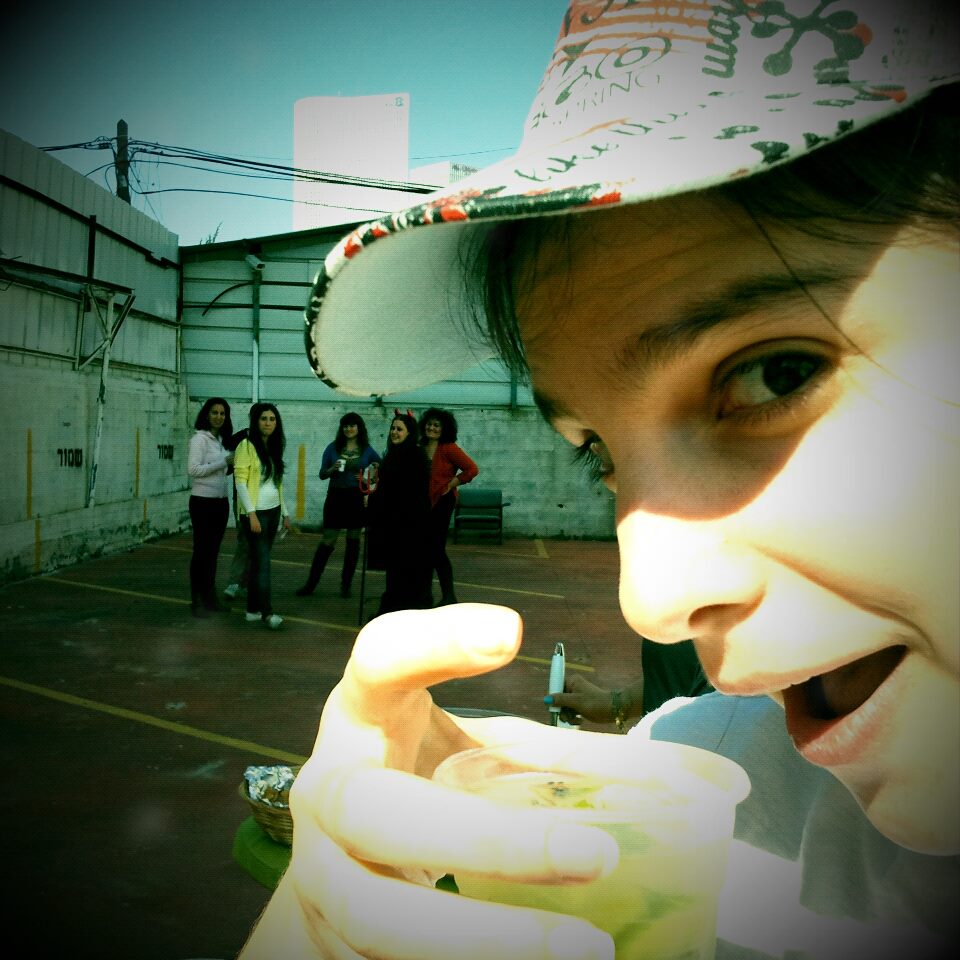
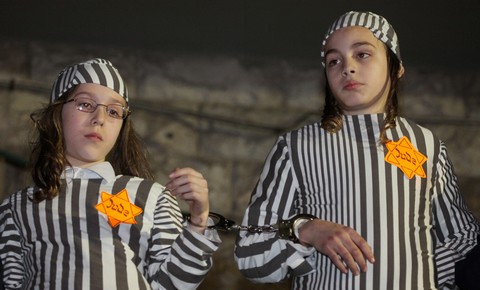
This year, I dressed up as Ashton Kutcher for Purim. People say there is a resemblance: You be the judge.

Also, when I stay with Uri at his family’s place, he often has conversations with his parents in the living room while I’m chilling in his room, which is a door away. He’ll then translate these conversations for me, especially if he’s talking about something that relates to me. Gradually over time, I’ve been able to understand more and more of their conversations. Last time, every time he came back he would start to translate and I would say, “Yes Uri, I heard.” He then pointed this out: “Laura, you can understand everything now! We can’t hide anything from you anymore!” I certainly hope that’s true…

But, with progress, there are always funny language mistakes along the way. This one has to be the best Hebrew mess-up I’ve had in Israel lately, and perhaps, ever. I was at a bar with a friend and trying to explain that another friend had recently gotten engaged. However, instead of saying “Hee hayta me’oresset,” which means she got engaged, I said, “Hee hayta me’onnenet.” They both sound similar, and I had learned both words within a few days of each other. When my friend started bursting with laughter, and asked, “Hee hayta me’onnenet al ma?” (“al ma” means “about what?”), I understood that I said the other word… which meant that I told him, “She was masturbating.”  I can tell you this: I’ll never forget either word now.

Lesson learned? Humiliation is the best way to remember the difference between love and masturbation. Or, just acquire a new language. You choose.

A picture of a drunk guy for good measure (Courtesy of Bistrosavage).

Hibernating and studying

Hi everyone,

I’m taking a break from writing for the time being to concentrate on becoming fluent in Hebrew. Since I came to Israel 16 months ago, I’ve been busy advancing two goals professionally: writing and learning Hebrew. However, I’ve been spending more time on the former than the latter. This made some sense, especially in the beginning, because I was entering journalism and needed to develop my portfolio in order to gain credibility. But now that I’ve written a number of pieces that I’m proud of, I need to face the music and study. Otherwise I won’t advance here professionally, or frankly, personally.

What learning Hebrew has looked like thus far. (Courtesy of Moriza at Creative Commons)

What learning Hebrew will hopefully look like (Courtesy of Brewbooks at Creative Commons)

What this also means is that when I start writing again, I’ll be able to do much more because I’ll be able to interview in Hebrew, which will open a whole lot of doors. So, stay tuned. In the mean time, I’ll write sporadic personal updates, but nothing professional for a while.

Hope you’re all doing well.


Arabs and Jews want to save lives

Featured

Some good news for once. Read my Jpost post about an inspirational group of Orthodox Jews (including ultra-Orthodox) and Arabs that save lives in East/West Jerusalem, as well as across Israel. Considering the most popular nonprofits seem to be public health related, they may be onto something. In fact, of the top 100 nonprofits around the world ranked by Global Journal, almost half of the top 25 are public health or humanitarian relief related.

What lessons do you think this group has for the peace movement? I’d love your thoughts, also because I’d like to delve into this deeper in my next post.

Holocaust free speech v. hate speech?

Featured

There was a bill backed recently that would forbid the use of the term Nazi or anything associated with the Holocaust in Israel. This reminded me of the lessons I learned from writing the, “What are Holocaust humor’s limits?” article, and decided to write a Jpost post connecting the two. You agree with my assessment? Let me know what you think! I’m very curious to get others’ reactions.

Ultra-Orthodox protestors; Photo by Marc Sellem

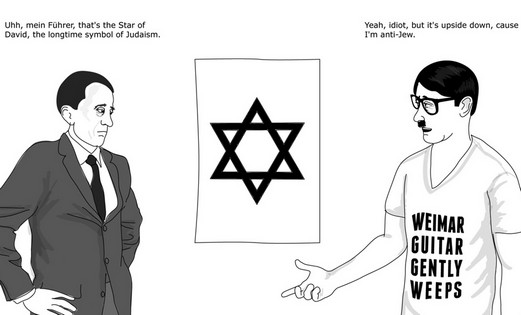
Hipster Hitler comic with T-shirt

Churning it out… Any ideas?

Well, so far I’ve been one of those writers that sits and stews on pieces for a while, and then all of a sudden, I post several articles within a short period of time. Unfortunately, this does not bode so well for regular blogging…

One of my editors told me recently that in order to stay on the Jpost blog site (especially because they’re looking to cut the bloggers down substantially), I’ll need to start writing once a week. He wanted me to stay, but cautioned me that I’d have to post more frequently. Eeck! It that was a kick in the butt to pump up my game. Which I’m trying to do.

This means that my approach to blogging will have to change. Instead of writing longer posts and posting less frequently, which is what I have been doing, I will have to write shorter posts but post more frequently. This means I will either describe short, clear stories, or spread out a piece over several posts.

Which leads me to ask you, my loyal readers, some valuable questions: If I could write about anything about Israel, what would most interest you? Which posts of mine have you liked more, and would like to see more of? Any and all ideas would be appreciated! Thanks!

Courtesy of lovelihood at Creative Commons

A word for losing a child

I wrote a new Jpost post reflecting on the fact that there’s a word in Hebrew for someone that loses a child. There’s a clip from Six Feet Under to compare Americans’ v. Israelis’ attitudes towards death. I guess there’s a reason I went back to Hebrew classes; language reveals so much. Let me know what you think.

PR photo

Six Feet Under PR Photo

Holocaust survivor creates moving art exhibition

Several weeks ago, I attended an amazing art exhibit by a Holocaust survivor. I was so moved that I wrote this review in the Jerusalem Post Lite below. The artist’s name is Israela Hargil, and the exhibit, Cherries and Golden Butterflies, is on display from now until January 1st at the Theater Art Gallery of Holon. It is about her experiences as a child during the Holocaust in Poland. (NOTE: the location has changed since the original publication.)

I posted this to my Jpost blog so I could encourage folks in Israel to see it. For those of you abroad, I merely urge you to read the review below. Hopefully this will bring you there in spirit.

Cherries and Golden Butterflies

A review of Israela Hargil’s exhibition about being a child during the Holocaust.

By LAURA ROSBROW


I see an art piece that consists of candy wrappers piled one-meter high. Above the candy wrappers there are metal wires hanging from the ceiling with candy wrappers tied along them, as if butterflies were flying above. Next to the piece, there is a poetic text explaining the story. The text ends by saying, “And one of the kids found a real sweet there.”

It is the story of an eight-year-old Jewish girl during the end of the Holocaust in Poland, remembering a candy factory being bombed. All the kids played with thousands of candy wrappers flying everywhere. Amidst this, one kid did find, “a real sweet there.”

This eight-year-old girl is now 73-year-old Israeli conceptual artist Israela Hargil, and this piece is part of her new exhibition, Cherries and Golden Butterflies, which can be seen at the Theater Art Gallery of Holon until January 1st, 2012. It is the third and final exhibition in a series of autobiographical work about being a child during the Holocaust.

Focusing on the end of the war, the exhibit captures the unique memories that only a child who survived the Holocaust could have: longing for a doll; pretending to be a “cow girl” to fit into the Polish family that was hiding her; buying a bag of cherries for only a penny. These sweet and dark memories are expressed through mixed media, combining elements such as photographs, found objects, personal writings and sculpture, Hargil’s specialty.

The exhibit has three large installations. The installations tell longer stories and have poetic text alongside them, such as the candy wrappers piece. These pieces are particularly strong. The size of the installations and the accuracy of the materials make you feel as if you are right there in her past.

The only other sculpture in the exhibit is also moving. It is a series of bronze bodies that express different stages of death. One particularly striking figure is crudely made, as if melted and without certain parts, lying like a body.

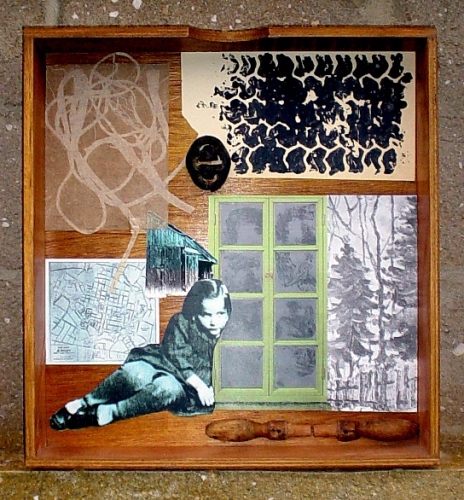
Most of the exhibit consists of what the artist calls “memory boxes,” that hang along the walls. Each of these is a cupboard filled with photographs and found objects from the artist’s past. Whereas the strength of her larger figures was in their sense of setting, the strongest memory boxes were more individually focused, all with photographs of the artist or her parents. These intimate views of her loneliness haunt the viewer.

Israela’s tale is amazing: She was born in 1938 in Poland. Only three years later, in 1941, her mother was killed. Soon afterwards, her father was convinced to place Israela, then called Eva, in the care of a Polish Christian family. During the Holocaust, Eva stayed with several families, often hiding under beds for months at a time.

Eventually her father, who became a Russian soldier during the war, came back. They both immigrated to Israel in 1948. Sadly, in 1952 he died of a heart attack. Israela remained on a childrens’ kibbutz.

For years this talented artist, who has exhibited at Yad Vashem and the Israel Museum, made abstract pieces. Only five years ago did she begin to do autobiographical work about the Holocaust.

After I saw the exhibit, which I was invited to through my friend (as well as her grandson), I wanted to interview her myself.

I asked her what inspired her to start doing work about the Holocaust. She explained that when she was around 12 years old she wrote a diary about this time. “I did it so I wouldn’t forget what happened during the war because my father was no longer with me. I wrote it so he’d read it and know what I went through.” She used these writings in her first two exhibitions, Photoerosion I and II.

She explained that when her father died (he had read some of her diary before), she inherited his papers: “From time to time, I would go to the attic and look at them,” she said. This went on for years. Then, around five years ago, she created a piece that had three empty boxes. The next thing that happened, “I made a collage of my mother, father, and me as a little girl.” And it just came out.

I asked why this is her last Holocaust exhibit?

She stated calmly, “I cleaned it out of my system. It made it easier. Now it’s not weighing so heavily on me.”

That’s good to hear.


For more information, visit Israela Hargil’s website: http://www.israela-hargil.co.il


Ch-ch-ch-changes: Part II

First, I must thank many of you who reached out to me after my last post. Your positive energy was much appreciated. I think it worked, because not only did I land my first contract writing gig, I also got rehired for my editing position. Yipee! The contract writing will be a part-time grant writing job that I can do from Israel. That’s a very exciting development and lovely way for me to step back into the nonprofit world. Then, the story about my position, well…how about you read this Jpost post, titled, “Working it: Some advice about journalism in Israel,” to get the full picture? :).

In any case, I’m very excited for these next steps and really appreciate all of your support. Hope you’re doing well, and look forward to seeing many of you in the Bay Area over Thanksgiving!

Courtesy of lovelihood at Creative Commons.


Ch-ch-ch-changes

Courtesy of qthomasbower at Creative Commons

Turn and face the strain, ch-ch-changes…

So yes, I have been going through some ch-ch-ch-changes lately. Which is partly why I’ve been a bit out of touch writing-wise. First, I moved to a new apartment! I basically moved from the less-hip border to the more-hip border of Tel Aviv’s African area. I suppose a little bit of Senegal always stayed with me, :).  This is both exciting because of the location and the fact that my place is a bunch nicer. These days, I’m all about improving my quality of life. Struggling is not as sexy or as sanctimonious as it once was.

The other change is professional. As some of you know, I was hired as a magazine editor for the Jerusalem Post on a maternity leave contract for six months. The woman I replaced is returning to her position in December, which means I am in the midst of finding work. Thankfully, I won’t be completely saying goodbye to the Post: I will keep my blog and will be proofreading part-time as well.

I am trying to take this change as an opportunity in disguise. Over the course of the last year, I have realized my true passion is writing. However, for me this can come in many forms. Much to my surprise, I even enjoyed editing a children’s magazine. So, even if the subject is not 100% my cup of tea, I still enjoy the work because it involves writing and being creative.

This realization also helped me understand that I want to get back into the nonprofit world. Part of why I burned out is because I went into nonprofit work believing my passion would be advocating for an issue. With this logic, it would just take time to figure out what that issue was. However, I was not as inspired by this as I thought I would be. I only found this passion when I began to write for a living.

Now, I am really excited to start consulting nonprofits and social profits on their communications! This would combine my newfound passion for writing and my first love for social justice issues. Considering I am between jobs, this seems like as good a time as any to try being self-employed, which is something I have been thinking about for a while.  Additionally, I hope this will also give me more time to pursue my own journalistic writing. 

So, friends and colleagues, if you know of anyone needing help with research, grant writing, evaluation planning or reporting, press releases, op-eds, website content, and marketing materials, I would be deeply grateful for referrals! I can work global hours and do video chats via Skype or Google Video.

Thank you all for your support throughout my first year in Israel and I look forward to being in touch.

Courtesy of Guy Sharett

Picture of Florentin, my new neighborhood! Courtesy of my friend Guy Sharett

Mom visited Israel during Gilad Shalit’s return

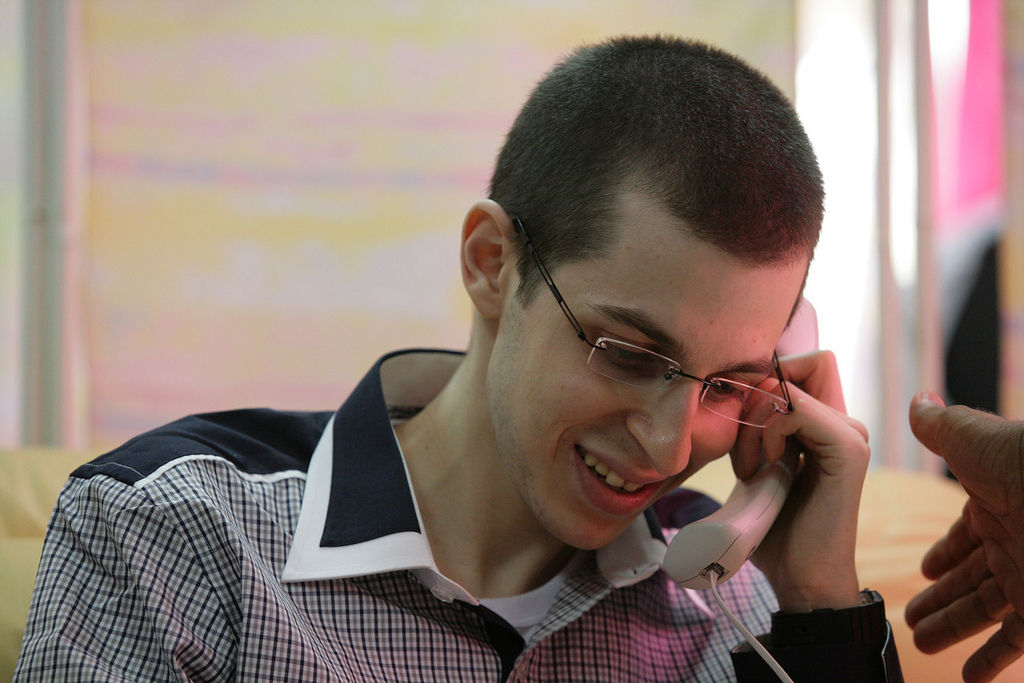
If it weren’t enough that my Mom visited me for the first time in Israel, she was also here when Gilad Shalit came back to Israel! Her insights as an outsider were very interesting. Read my new Jpost post to see the full story!

Gilad Shalit on the phone with his mother just after being released; Courtesy of Israel Defense Forces